Black Panther Party Heritage Trail in Illinois
Site 2
Fred Hampton, Mark Clark Assassination Site
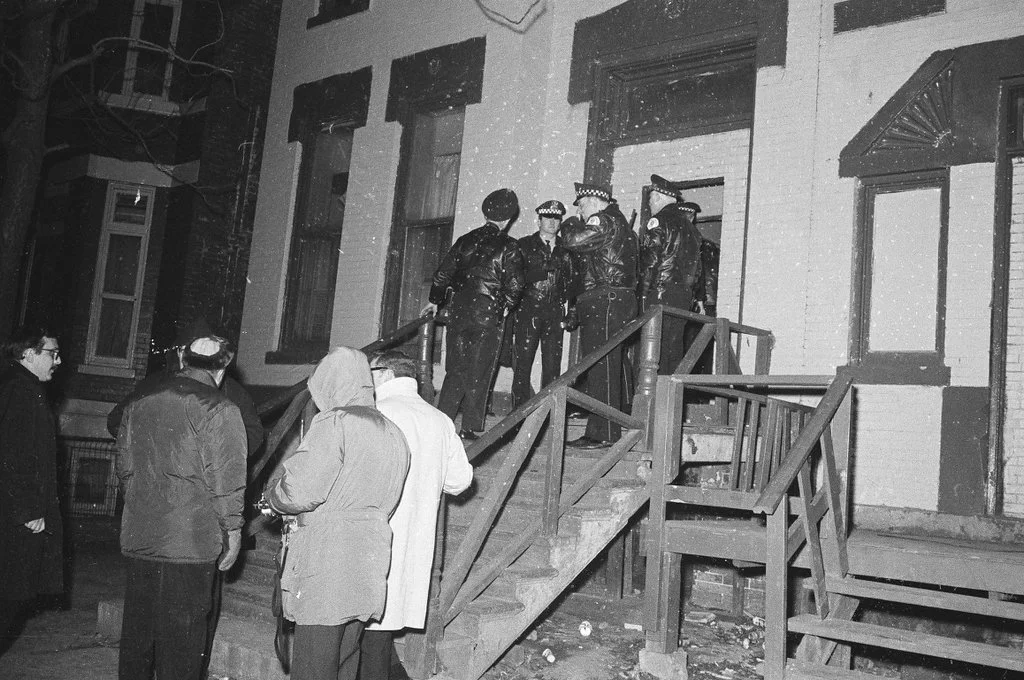
Photo: December 4, 1969, moments before Chicago Police carry out the body of Illinois Deputy Chairman Fred Hampton after an FBI-coordinated assassination. Credit: Joe Marino, ST-19030974-0004, Chicago Sun-Times collection, Chicago History Museum
Site 2: Fred Hampton, Mark Clark Assassination Site
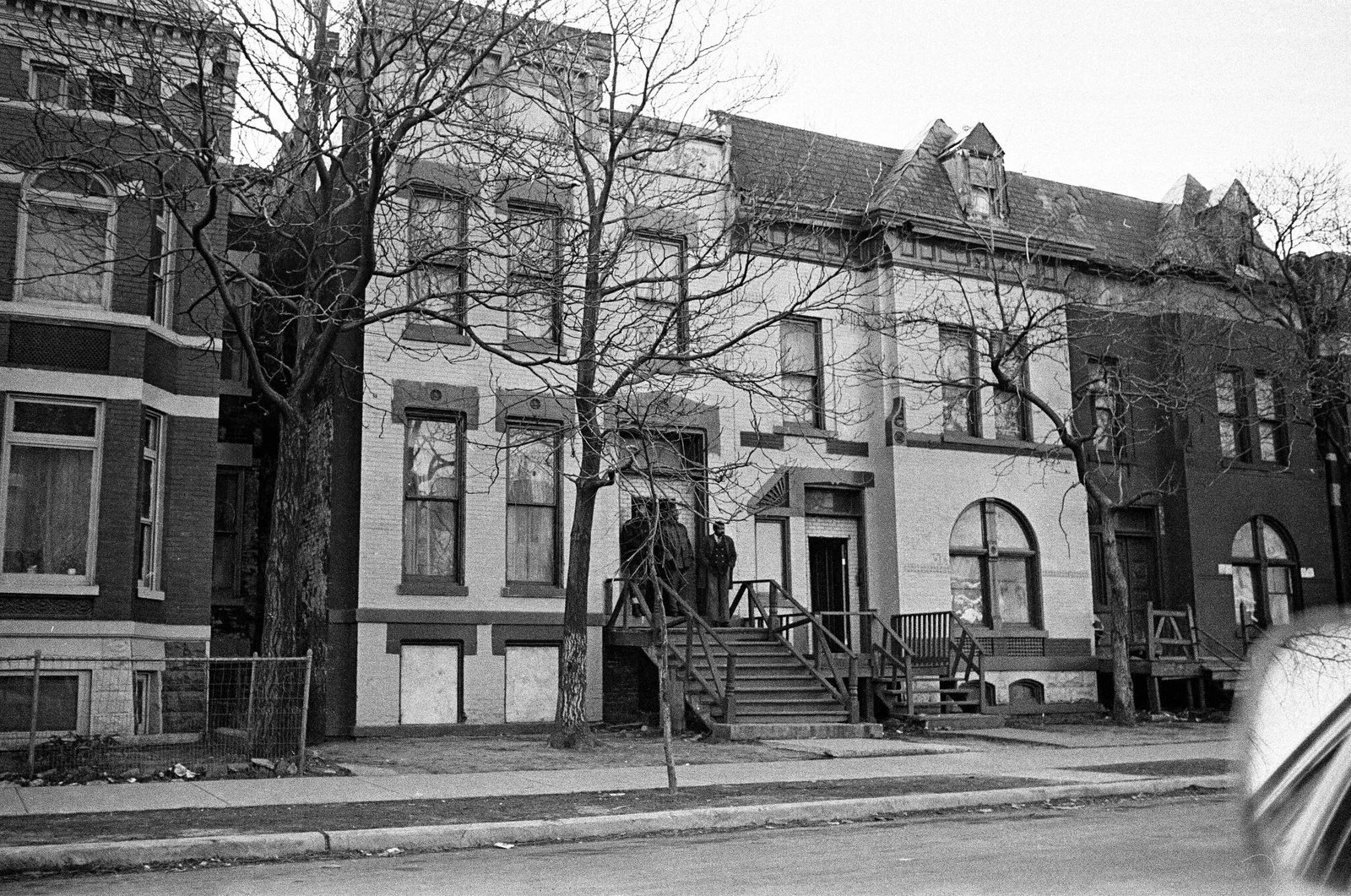
Word traveled fast after the illegal raid and assassination. Several of the occupants of 2337 W. Monroe were shot and taken into custody. As day breaks, Panthers are shown at the location before the public arrives. Credit: Joe Marino, ST-19030974-0010, Chicago Sun-Times collection, Chicago History Museum
Site 2
Name
Assassination Site
Location
2337 W. Monroe, Chicago, IL 60612, Near West Side, Mile Square
Historical Period of Significance
1969.
Original Structure
Demolished.
Panther Activities
Residence of Fred Hampton
Housing and leadership organizing site (“Panther Crib”)
Site of the December 4, 1969, police raid and assassination of Fred Hampton and Mark Clark
Historical Marker Installation Status
Not yet Installed.
December 4, 1969
Photo: December 4, 1969, moments before Chicago Police carry out the body of Illinois Deputy Chairman Fred Hampton after an FBI-coordinated assassination. Credit: Joe Marino, ST-19030974-0004, Chicago Sun-Times collection, Chicago History Museum
The Panthers declared 1969 the Year of the Youth.
J. Edgar Hoover declared the Party the greatest threat to the internal security of the United States.
He pledged to destroy it by the end of the year.
Police repression increased across the country. Branches and chapter offices were being raided, including at least three raids on the Illinois Chapter’s headquarters. Leaders were killed, beaten, and jailed. In Illinois, Fred Hampton's appeal was denied, and he was to turn himself in to begin serving a two-to-five-year prison sentence.
The Illinois Chapter had a purge. The frequent friction with law enforcement made suspicion and paranoia palpable; flushing out informants was central to the path forward. All members were demoted from Panthers to Community Workers and had to earn their titles back. Then, on November 13, 1969, Spurgeon "Jake" Winters was in a gunfight with Chicago police at 5801 S. Calumet. This location is now an empty lot. Jake was an expert marksman who was firearms-trained by his father and had just been purged. He and two Chicago police officers lost their lives that night.
On November 19, within a week of the gun battle, FBI Special Agent Roy Mitchell called his informant in. FBI Informant William O'Neal provided the floor plan to the Panther crib where Fred and other Panthers lived. Several members of the assassination squad had been involved in the Jake Winters gunfight.
The Illinois Panthers called a leadership meeting, and on December 3, Illinois leadership arrived in Chicago, including Mark Clark, Peoria's leader and Defense Captain. Fred Hampton led the political education class that night, and the plan was for the Illinois leadership to gather at the 2337 W. Monroe apartment afterward for a meeting. Known as a “Panther Crib,” where Party members lived communally, the apartment at 2337 W. Monroe served as the residence of Illinois Deputy Chairman Fred Hampton, Illinois Deputy Minister of Education Billy Brooks, and other Party members. It was less than a block from headquarters at 2350 W. Madison and served as an important organizing space for Party leadership.
O’Neal would have let Mitchell know that all of Illinois’ Party leadership would be at the meeting and then the apartment. The Gang Intelligence Unit had its own informants and would also know.
Leadership discussions centered on several questions: would Fred turn himself in, would he go underground and leave the country, or something else? The FBI discussed these same questions. In its files, allowing Fred to turn himself in would create a movement like the “Free Huey!” movement and make him larger than life. Going underground and emerging overseas, as Eldridge Cleaver did, would allow him to influence the Party and politics. No. Neither of those was ideal, as far as the FBI was concerned.
After the political education meeting, William O'Neal picked up Fred’s girlfriend Deborah Johnson, who had been at a friend's house that night. Both went to the apartment.
Reports on what happened at the apartment vary. As it became very late, members who lived elsewhere returned to other Panther cribs and homes. Deputy Minister of Defense Bobby Rush, Deputy Minister of Information Chaka Walls, and others left the apartment. A total of nine people remained in the apartment.
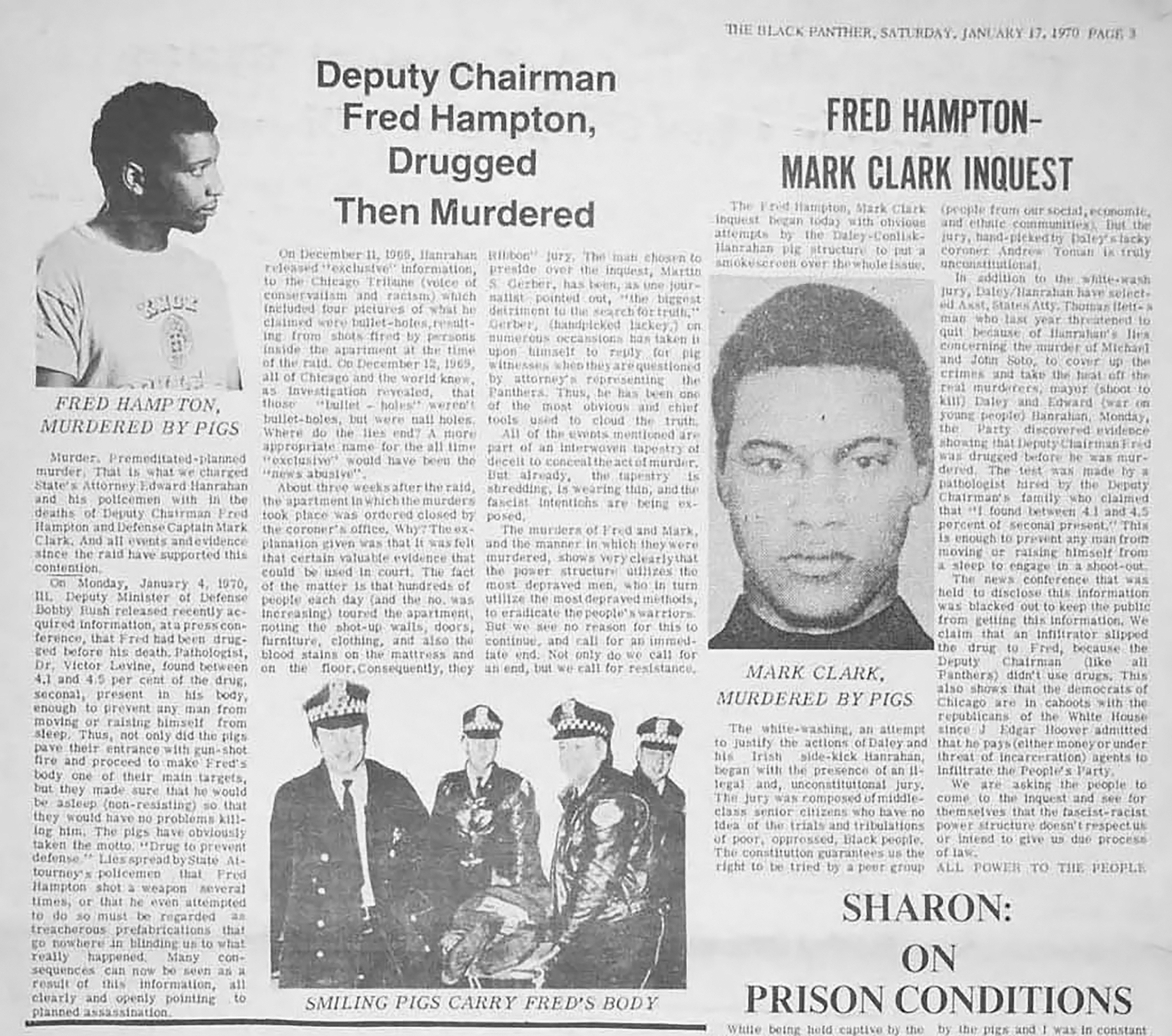
January 17, 1970, edition of The Black Panther newspaper recounting a Panther press conference on January 4, 1970. At the press conference, Bobby Rush announces that an independent autopsy found an extremely heavy dose of the barbiturate Seconal in Fred Hampton’s blood that rendered him totally incapacitated.
Sometime during the night, Fred Hampton was drugged with the powerful barbiturate Seconal.
Between approximately 4:30 a.m. and 4:45 a.m. on December 4, 1969, Chicago police arrived. They shot through the front door, instantly killing Mark Clark. Mark had just gotten on security at the door less than an hour before. As the police shot their way to Fred Hampton’s bedroom, Ronald "Doc" Satchel, Brenda Harris, Blair Anderson, and Verlina Brewer were hit multiple times. Fred Hampton was shot multiple times, even at point-blank range. Deborah Johnson, Harold Bell, and Louis Truelock survived without being shot.
As word of the raid and Fred Hampton's death spread, Panthers began calling the apartment. Chicago police answered the telephone, laughing as they told callers, "The Chairman is dead." As daylight began, the police hurried out of the area and left the apartment unsecured.
That very day, Cook County State’s Attorney Edward Hanrahan was on the radio describing the events as a shootout and claiming that his officers were under attack by the Panthers. That very day, the Panthers conducted tours of the apartment to show the community what took place. After Panther lawyers received ballistic reports, the evidence showed that police fired 99 bullets into the apartment and at its residents. The one bullet attributed to the Panthers was a reflexive shot from Mark Clark as he fell backward after he was killed.
Fred Hampton's assassination remains one of the most significant political assassinations in United States history and one of the most consequential examples of coordinated FBI and police action against a political organization.
PHOTOS
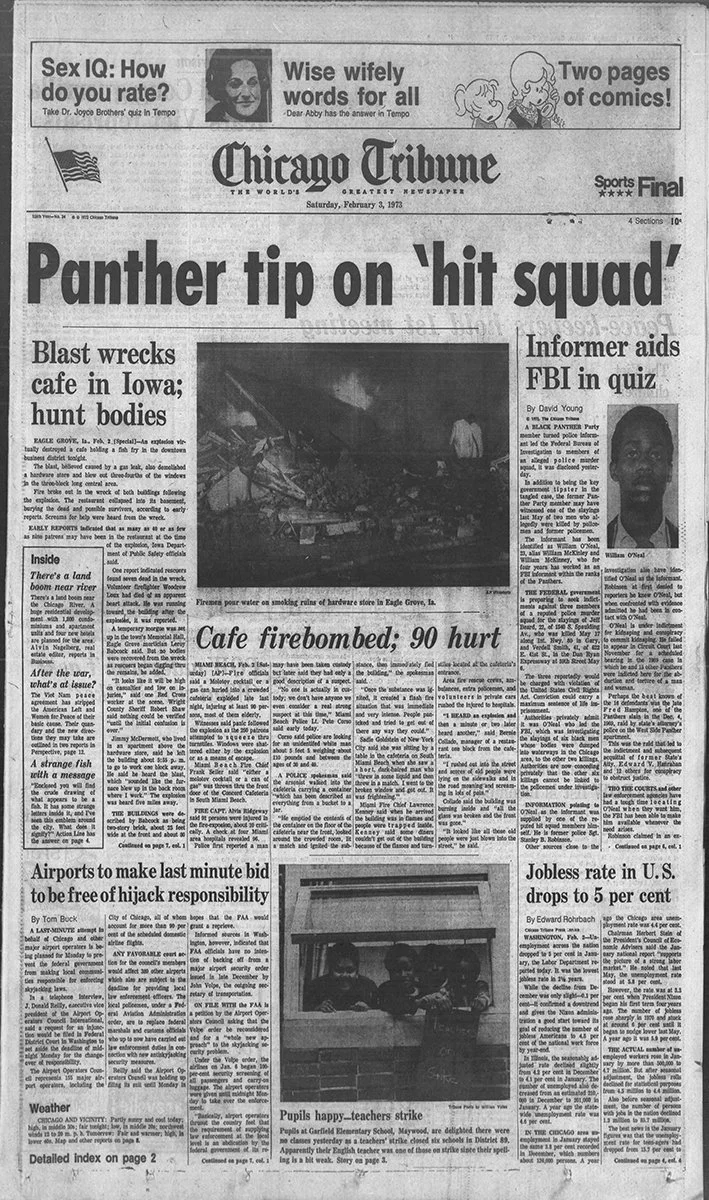
On the front page of the February 3, 1973, edition of the Chicago Tribune is an article covering the trial of corrupt police officer Stanley Robinson. Robinson identified O'Neal as an informant. In court, it was revealed that O'Neal had informed on the Panthers for four years, and that law enforcement could never reach him, but the FBI could produce him at will. Robinson was part of a police "hit squad" that committed multiple murders.
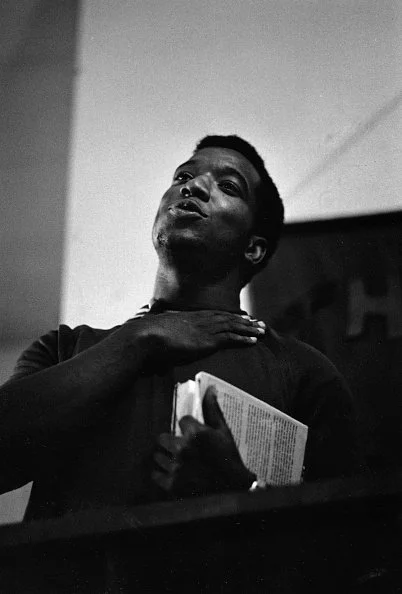
August 1969. Fred Hampton, recently released from Menard prison on an appeal bond, officiates the Panther wedding of Chaka Walls and Wanda Ross at Trinity Lutheran Church, 4837 S. State Street in Chicago. Photographer Paul Sequeira had unprecedented access to the Illinois Panthers.
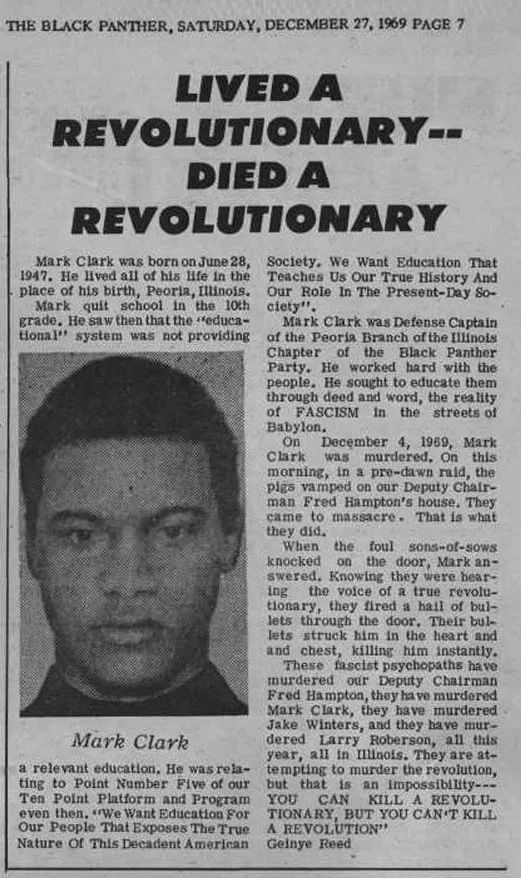
The December 27, 1969, issue of The Black Panther newspaper includes an obituary for Mark Clark. Like Fred Hampton, Mark was in the NAACP before joining the Black Panther Party. Mark was Defense Captain and leader of the Peoria branch of the Illinois Chapter. He started a Free Breakfast for Children Program, held Political Education classes, and recruited new members. He had just taken on guard duty at approximately 4:00 a.m. before the assassination squad arrived. Mark was killed by a police bullet in his heart.
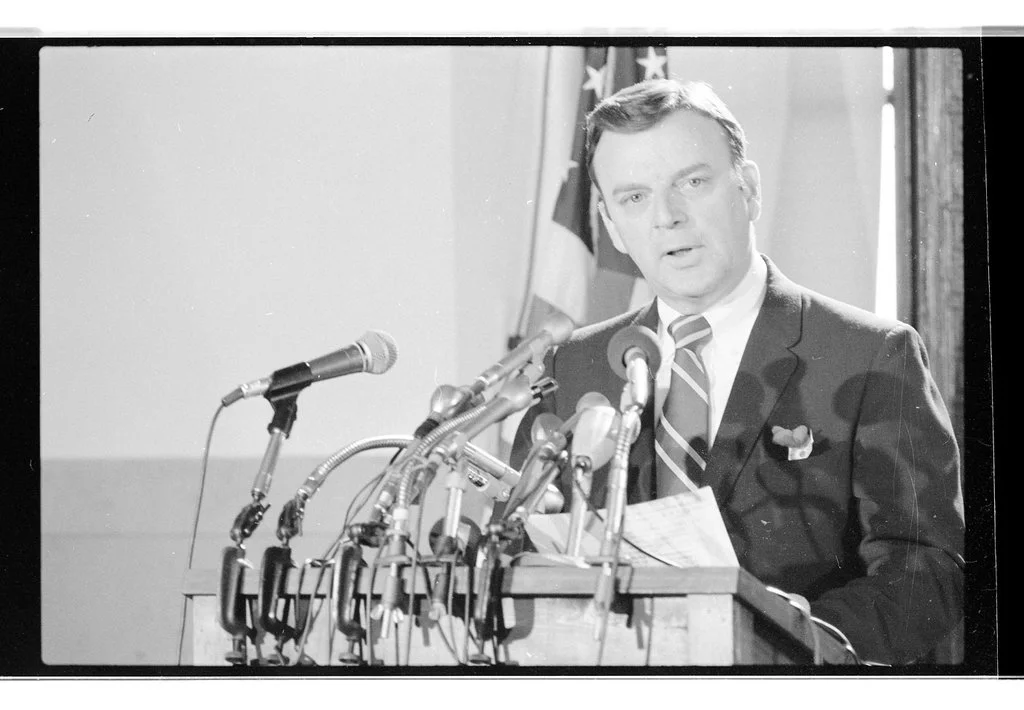
May 22, 1970. Cook County State's Attorney Edward Hanrahan addresses the press after a federal grand jury criticized his office and the Chicago Police Department for their handling of the raid that killed Fred Hampton and Mark Clark. Later investigations found that the FBI and Chicago police had colluded to assassinate Fred Hampton. Photographer Duane Hall, ST-17101247A-0012, Chicago Sun-Times collection, Chicago History Museum
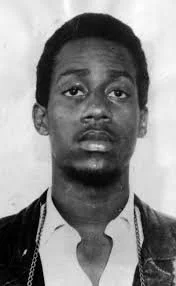
Mugshot of FBI informant and provocateur William O'Neal. During his time in the Panther Party, O'Neal committed numerous crimes and schemes to entrap Panthers into arrests and prison, and ultimately conspired in the assassination of the Illinois Deputy Chairman Fred Hampton.
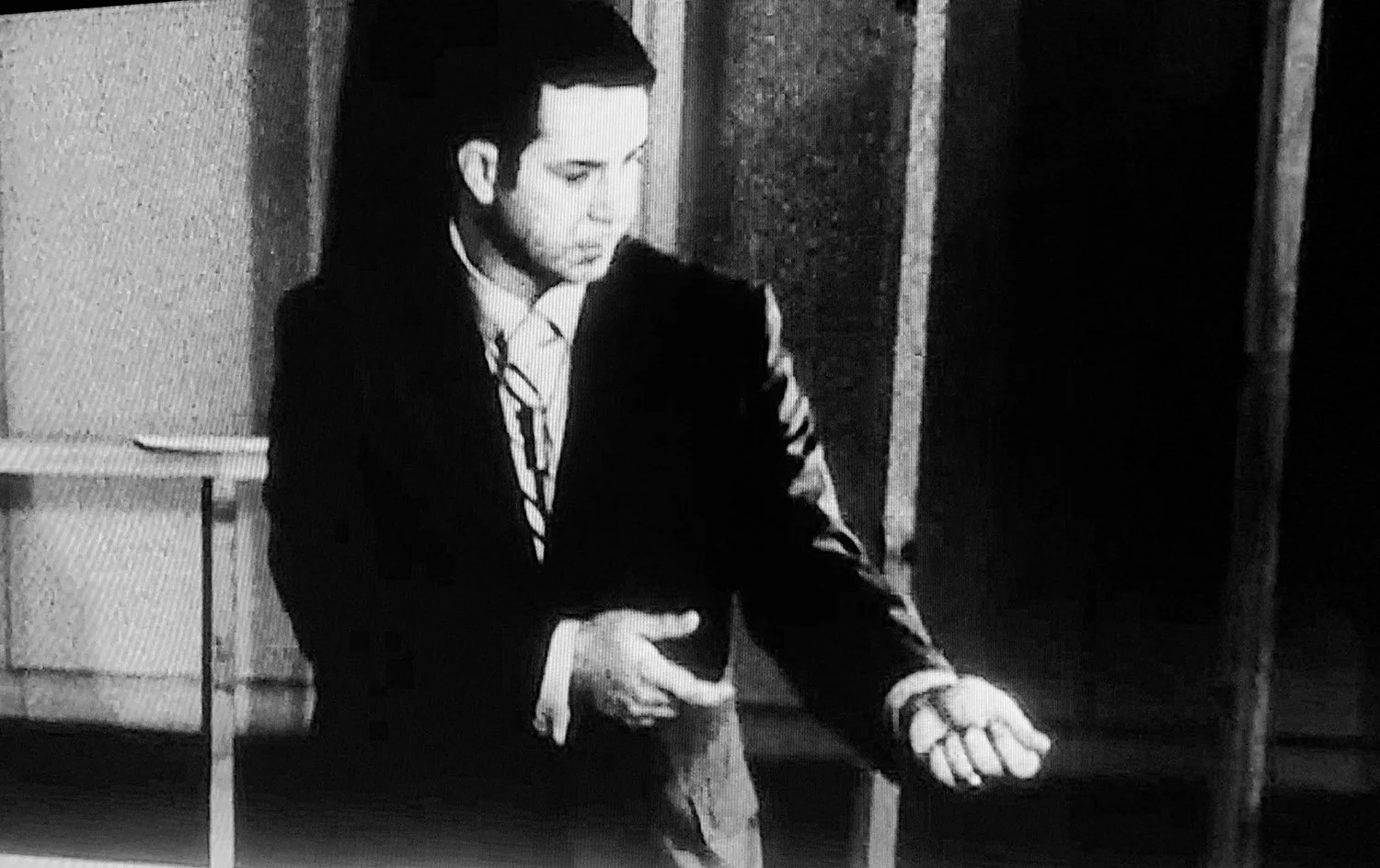
The assassination squad from State's Attorney Hanrahan's Chicago Police unit performs a reenactment of the raid. Officer Daniel Groth said he was fired upon by the Panthers in a hail of gunfire. Ballistic reports would later show that 99 bullets came from police, and one from the Panthers. The one could have been a reflexive shot from Mark Clark's gun when he was shot.
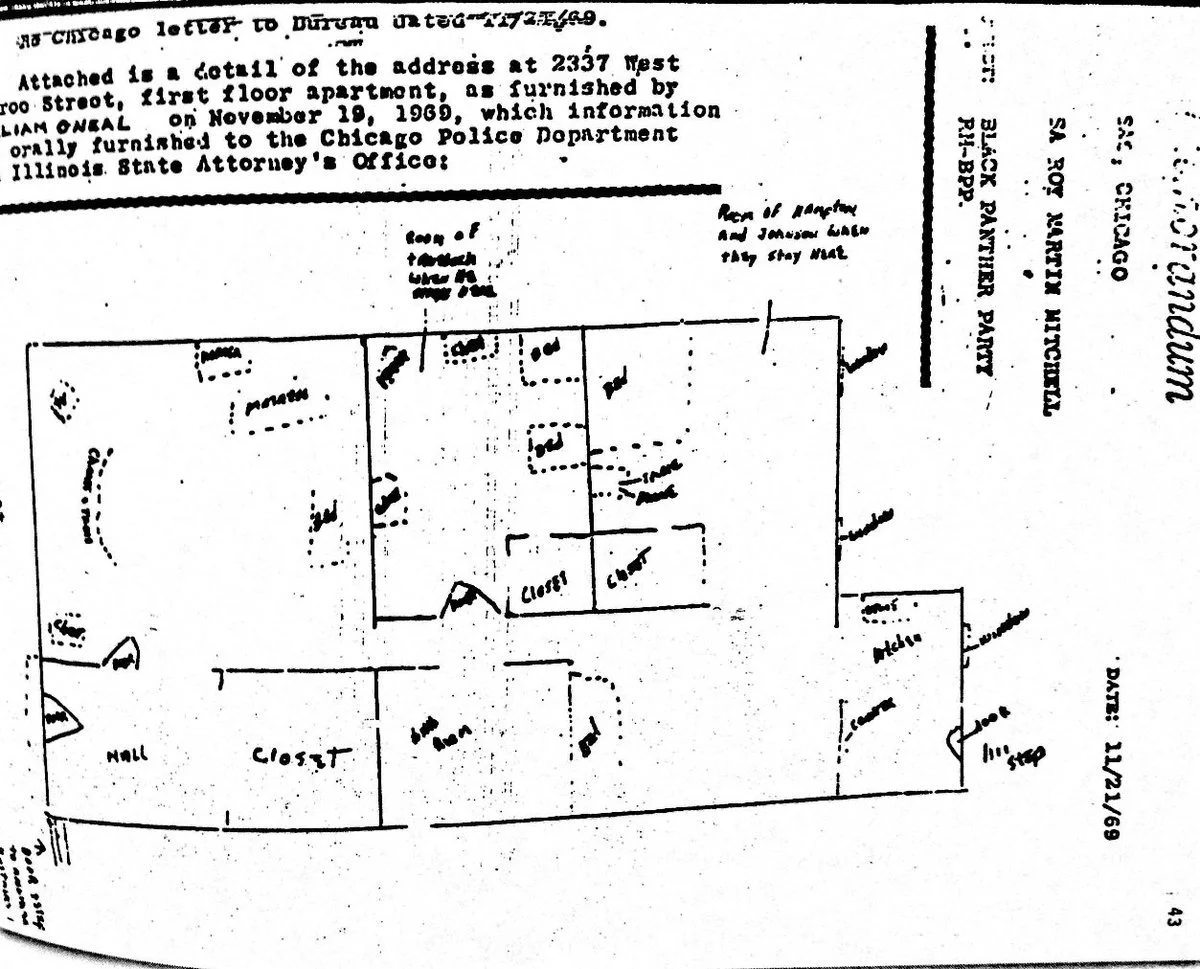
In a circulated FBI Memo dated November 21, 1969, a week after the Spurgeon "Jake" Winters gun battle with Chicago Police, is a sketch of the 2337 W. Monroe Panther crib. A note says the information had been furnished to the Chicago Police and the Cook County State's Attorney's office.
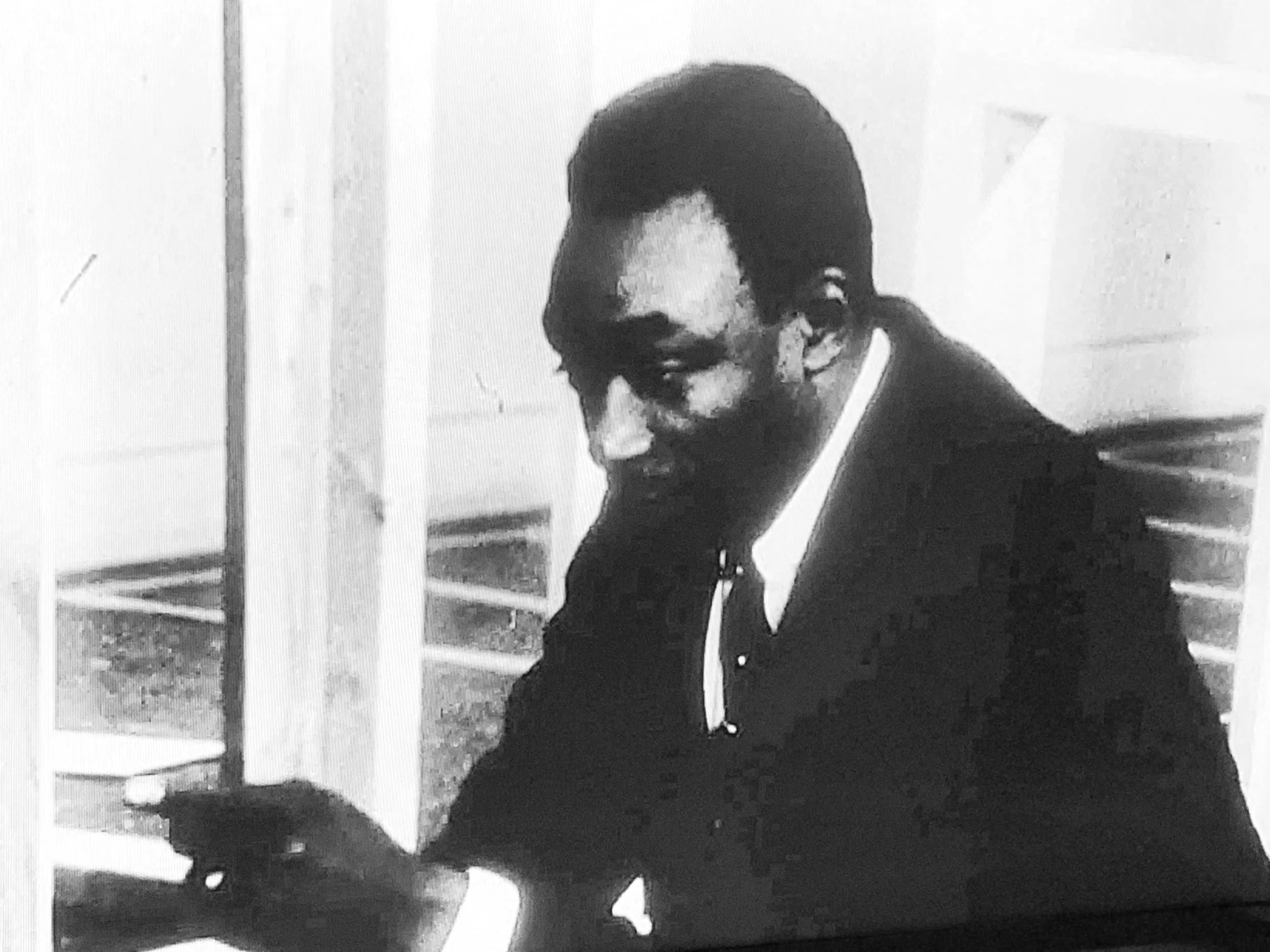
The assassination squad from State's Attorney Hanrahan's Chicago Police unit performs a reenactment of the raid. Officer James "Gloves" Davis was said to be so brutal that he often wore black leather gloves to beat people he arrested. Davis also said he was fired upon by the Panthers in a hail of gunfire. Ballistic reports would later show that 99 bullets came from police, and one from the Panthers. The one could have been a reflexive shot from Mark Clark's gun when he was shot.